
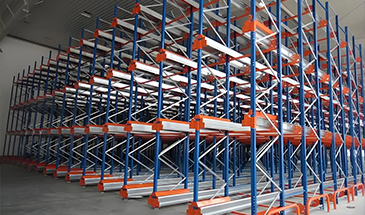
Shuttle car shelves lead the intelligent upgrade of warehousing and logistics
Definition
The shuttle car shelving system is a high-density, semi automated storage shelving system. Its core consists of three parts:
(1). Shelf body: composed of multiple layers and columns of dense shelf channels, usually of a through type, with no space for personnel or forklifts to walk inside the channels.
(2). Shuttle car: a small intelligent robot that runs on a predetermined track. It can accept instructions and independently perform forward/backward and pallet access operations within the shelf aisle.
(3). Drive and control system: Forklifts or elevators are responsible for transporting shuttle vehicles to different entry points on different levels, and issuing operation instructions to the shuttle vehicles through handheld terminals or warehouse management systems (WMS).
Simply put, it replaces the forklift's operation in the aisle with a "smart car that can run" in traditional through type shelves, achieving "vehicle carrying cargo movement" instead of "vehicle entering the cargo aisle".
Core Features
The characteristics of its intelligent upgrade are mainly reflected in the following aspects:
(1). High density storage with extremely high space utilization
The shelf channel design is compact, requiring only a small amount of inspection space to be reserved, without the need for internal forklift channels, resulting in a storage density much higher than that of crossbeam shelves, approaching the level of drive in shelves, and increasing space utilization by 30% -80%.
(2). Revolution in homework mode, dual improvement of efficiency and safety
Human vehicle separation, safe and reliable: Forklift drivers only need to work outside the aisle, without entering narrow and dangerous shelves, greatly reducing the risk of accidents and shelf collision damage.
Parallel operation, doubled efficiency: Multiple shuttle cars can operate independently in different channels at the same time, and access operations do not interfere with each other. It is particularly suitable for large-scale and relatively single category goods entering and exiting the warehouse, and the overall operational efficiency is significantly improved.
First in, first out (FIFO) or first in, last out (FILO) are flexible options: through system command control, two inventory management modes can be easily implemented to meet the management needs of different goods.
(3). Intelligent and Information Management
Instruction driven, precise operation: All operations are controlled by wireless instructions, reducing human judgment and operational errors, and achieving precise location management.
Real time inventory visualization: After integration with the WMS system, the system can track the position and status of each pallet in real-time, ensuring accurate inventory data and providing a foundation for refined management.
Path and task optimization: Intelligent systems can optimize the operation path and task sequence of shuttle cars, further improving efficiency.
(4). Flexibility and Scalability
The system configuration is flexible, and the number of shuttle buses can be increased or decreased according to the throughput requirements of the warehouse.
The requirements for the load-bearing capacity and building height of the warehouse floor are relatively lower compared to automated three-dimensional warehouses (AS/RS), and the adaptability of renovation and implementation is stronger.
(5). Reduce long-term operating costs
Although the initial investment is relatively high, it can effectively reduce the comprehensive operating costs such as manpower, energy consumption, and equipment maintenance in the long run by reducing the number of channels, decreasing reliance on forklift numbers and driver skills, and improving operational efficiency.